Galactiv8
Galactiv8 Ultimate MIDI Pack
Galactiv8 Ultimate MIDI Pack
Couldn't load pickup availability
A complete package of over 600,000+ MIDI files.
Exploring many scales in every key:
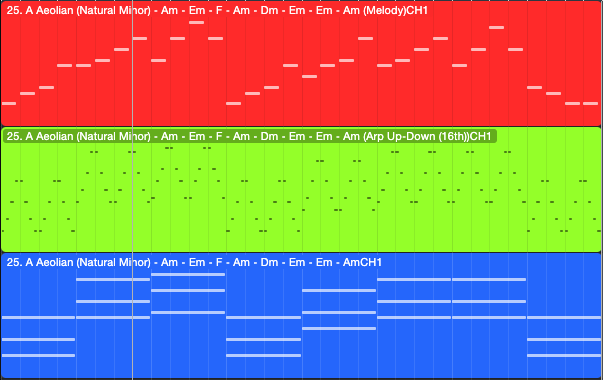
Multiple MIDI file types:
- Arpeggios
- Bass lines
- Chords
- Melodies
- Progressions
- Stabs
- Alternate voicings
Drag and drop these MIDI files into your DAW for super quick creation of progressions.
Scales included:
- Aeolian (Natural Minor)
- Altered Scale
- Arabic Maqam
- Augmented
- Bebop Dominant
- Bebop Major
- Blues
- Chromatic
- Diminished
- Dorian
- Double Harmonic
- Enigmatic
- Gypsy
- Harmonic Minor
- Hirajoshi
- Hungarian Minor
- In Sen
- lonian (Major)
- Iwato
- Locrian
- Lydian
- Lydian Dominant
- Major Blues
- Major Pentatonic
- Melodic Minor
- Minor Pentatonic
- Mixolydian
- Neapolitan Major
- Neapolitan Minor
- Persian
- Phrygian
- Phrygian Dominant
- Prometheus
- Spanish
- Ukrainian
- Whole Tone
Includes unique signature variations that highlight the cultural vibe / identity of the exotic scales.
Includes a starter pack for beginners and the full pack for more advanced progressions.
What Makes This Pack Unique?
Most MIDI packs give you notes. This one gives you music that knows where it comes from.
Every file in this pack was generated by an engine built on documented music research - from a 19th-century Japanese treatise to Arabic maqam theory to flamenco performance
practice, and every musical claim behind it is written down, sourced, and explained in the "About this scale" guide inside each folder.
Here is what that means in practice.
1. Melodies That Rise And Fall Differently - On Purpose
Many of the world's scales are not the same going up as they are coming down. The melodic minor is the famous example, but the same is true of Japanese koto scales, Maqam Hijaz Kar, flamenco's Spanish Phrygian, and Verdi's enigmatic scale.
Eleven scales in this pack are DIRECTION-AWARE: when a melody or arpeggio climbs, it uses the scale's ascending form; when it falls, it uses the descending form. Your DAW has never done this. Almost no MIDI pack ever has.
A few examples:
- Melodic Minor rises with a raised 6th and 7th and falls back into natural minor -- exactly as classical practice prescribes.
- The Spanish scale rises with a bright major third and falls with a dark minor third: the flamenco "mixed thirds" that mirror the Andalusian cadence.
- In Sen, Hirajoshi and Iwato follow the ascending and descending forms documented in Uehara Rokushiro's 1895 study of Japanese melody - including his rule that the two alternate tones never sound back to back.
- Arabic Maqam (Hijaz Kar) lowers its 7th on the way down, as maqam performance practice expects.
Where the research said "this tradition's directionality is about phrasing or ornament, not different notes" (blues, harmonic minor, Hungarian minor, and others), we did NOT force
it - those scales stay honest.
2. Melodies Built Like Hooks, Not Scale Exercises
Every melody follows a real phrase plan: a motif is STATED, then ANSWERED with a varied ending, then CONTRASTED, then RESTATED - and every phrase closes with a proper cadence.
That call-and-answer repetition is the oldest songwriting trick there is, and it is why these melodies sound intentional instead of wandering.
The shapes themselves respond to each progression's mood:
building progressions climb, melancholy ones fall, and the long-form 8/16/32-bar arcs cadence at the end of every section.
3. Cultural Phrasing, Not Just Cultural Notes
Scales carry their tradition's sense of phrase:
- Maqam and flamenco melodies open high and descend - the characteristic sayr of Hijaz Kar and the falling gesture of the Andalusian cadence.
- Japanese scales play sparser lines that orbit and land on the two "nuclear tones" of tetrachord theory.
- Persian phrases end with a forud -- the descending cadence onto the tonic that defines dastgah performance.
- Bebop scales favor descending runs, and their extra passing tone appears only on the way down, exactly as bebop pedagogy teaches it.
- Scales with a signature color tone (Phrygian Dominant, Double Harmonic, Hungarian Minor and family) get idiomatic ornament figures - turns and leans, not repeated notes.
4. Played Dynamics, Producer-Friendly Grid
Melodies, arpeggios, bass lines and stabs carry real per-note velocities: downbeats lean harder, melodic peaks swell, phrase endings breathe, subdued versions play soft and close, intense versions hit wide and hard.
Two deliberate exceptions, for your benefit:
- Timing is NEVER humanized. Everything sits perfectly on the grid, ready for your own groove and swing settings.
- Block chord progressions and voicings keep flat velocity and full-bar holds - they are raw material for YOUR performance, not ours.
5. Basslines That Know The Style
Six bass behaviors, chosen by the scale's culture and the progression's mood: jazz scales get a walking bass with chromatic approach notes into every chord change; flamenco and maqam scales get a grounded pulse; builds pump driving eighths;
intense versions bounce octaves; calm moods hold a deep root.
6. It Teaches While It Delivers
Every scale folder contains "About this scale.txt":
- one plain-language line if you are new to theory,
- one theory line if you are not,
- the exact notes in your chosen key,
- and, for direction-aware scales, both forms spelled out with the tradition they come from and how firmly the rule is documented (strict rule / strong convention / soft preference).
We are honest about limits, too: real maqam and dastgah performance uses microtones that standard MIDI cannot carry. Those folders say so, and tell you what to listen for.
7. Two Ways In
FULL PACK: 36 scales x 12 keys x 46 progressions - every voicing, arpeggio pattern, triplet feel, and signature variant.
STARTER PACK: one key (C), 12 essential scales, the single best progression for each mood, core files only. Small enough to explore in an afternoon, musical enough to finish a track with.
Filenames carry their mood tags, every file embeds its description in the MIDI itself, and everything is deterministic - the same settings always produce the same pack, so you can rely on what you heard yesterday.
Every progression, in every scale, in every key. Researched, sourced, and generated with the rules the music itself asks for.
Download the zip files and explore the pack instantly.
Works in any DAW that supports MIDI files.
LARGE FILE - MAY TAKE A WHILE TO UNZIP - STORING ON DROPBOX TAKES A LONG TIME TO SYNC DUE TO THE AMOUNT OF SMALL FILES (630,000+ files)
Share